Category: Shooting

Backlighting transparent objects with strobe

February 4th, 2012 Permalink

Some experiments in backlighting using strobes.

As a film shooter, I can’t just make a rough guess at flash exposure and then dial it in from there by test shots. Well, I can, but the turnaround time is a little high using regular film and doing it with Fuji pack film like the commercial shooters used to do isn’t cheap even if you do have a camera which accepts a Polaroid back (I don’t).

This is why, when I splashed out and bought a handheld meter, I made sure it also had flash metering capability. This makes it very easy to get a good exposure for reflective subjects, just point the meter back at the flash and have at it.

But it wasn’t at all clear how this would translate to subjects which allow light to pass through. Would metering as normal produce a transmissive object with the right amount of “glow”?

So as any good science-and-logic oriented person would do, I performed an experiment, with 5 shots bracketed at -2 through +2 stops from a normal meter reading, in 1 stop intervals. The flash was aimed from behind and to one side of a clear lead crystal candlestick, and goboed to prevent any output directly striking the lens.

The results were as follows, all shots being straight “proof scans” from the negative (made through the clear binder sleeve, so disregard any hairs or dust) with standard setting of white and black points for the film and development used; my normal method of proofing a complete roll.

The shot as metered (center) has a very good overall “glow”, but depending on intent -1 would also work and +1 might be OK for some cases. This is good enough to satisfy me that I can get the result I’d like. I haven’t tried lighting from beneath a clear object but this would obviously be a good point to start from as it’s the same basic principle.

A more complete shot would usually also include some degree of lighting to fill in the shadows, of course.

Guitar Man

December 2nd, 2011 Permalink

Guitar Man, a photo by Paul Glover on Flickr. So, out shooting around Grandin Village and I’ll be darned if this guy didn’t come walking around the corner. Not what you expect to see often, though perhaps it’s not unusual around Grandin Village. A moment or two of uncoordinated bluster and almost without thinking, I’m [...]

Guitar Man by Paul Glover
Guitar Man, a photo by Paul Glover on Flickr.

So, out shooting around Grandin Village and I’ll be darned if this guy didn’t come walking around the corner. Not what you expect to see often, though perhaps it’s not unusual around Grandin Village.

A moment or two of uncoordinated bluster and almost without thinking, I’m asking if he minds me taking a photo of him. “No” he says, and strikes a suitably musical pose.

“Ka-Chunk” goes the F-1, I wind on and thank him. We head off on our separate artistic ways. I could get the hang of this street portraiture thing, perhaps.

Ilford HP5+ part 1

November 20th, 2011 Permalink

First impressions of Ilford’s HP5+.

My first two rolls of Ilford‘s HP5+ film have been shot and developed.

The film was shot at box speed (400) metered using the ever reliable Gossen Luna Pro F. I developed in Rodinal 1+50 dilution for 11 minutes at 68F. This is the official time recommended by Ilford and also listed in the Massive Dev Chart.

First of all, I’m pretty certain that the development time was too short. Almost all of the negatives came out quite thin. I know my metering was correct, especially so for the incident metered shots which were very consistent in their difference from what I consider normal. I’m reasonably sure that the Yashica’s shutter speeds are in spec, or certainly not out by a stop or more. I haven’t had any trouble with previous rolls of Tri-X, Acros and Ektar run through it. I used all the shutter speeds throughout the roll and counted out some exposures in the 2-4 second range with the shutter set to bulb. Just can’t see all the speeds suddenly being out of whack by the same amount and my counting to be off by the same amount.

Also the edge markings on the film seem to be rather thin-looking.

So next roll I develop I’ll try something else. Possibly 13 minutes with normal agitation (30 seconds at start, 3 inversions every minute).

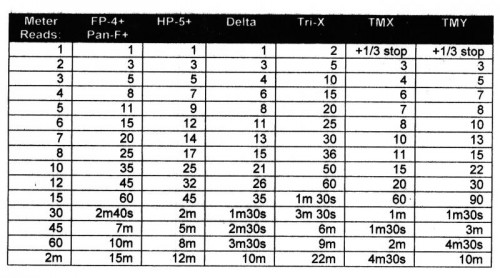
I also got a reasonable answer on my “which reciprocity adjustments to use” question: the Ilford official adjustments resulted in an overly dense negative, even with everything else on the roll looking thin. The shorter time garnered from testing yielded a negative with tones a lot closer to the other shots on the two rolls. I’m going to stick with those times and throw the datasheet’s recommendations under the bus.

I did notice that the lights in my night shots seem to be very dense despite the underdevelopment. Perhaps this film would respond well to a reduced agitation approach. Perhaps I’m used to Fuji Acros 100′s ridiculous ability to hold onto highlights.

What else? I like what I see so far in terms of detail and grain (supposedly Rodinal and HP5+ are not a match made in heaven, but I’m not seeing any big problem. Then again I’m not pathologically averse to grain either). I’ll be picking up another few rolls of this and refining my development.

Up to now I’ve been shooting a lot of Fuji Acros 100 and the Freestyle “white label” version of the same (Legacy Pro 100). I haven’t really had to think very hard about the issue of reciprocity failure as a result.

Reciprocity failure is where the normal relationship of 1 stop of shutter speed being reciprocated by one stop of aperture in the opposite direction breaks down, and where an extra stop of exposure requires significantly more than double the exposure time. All films suffer it to some degree. Digital capture remains linear for any exposure time, but the trade-off is often increased noise.

With Acros/LP100 that doesn’t happen until you hit exposure times of over two minutes, and to date I’ve yet to run into a situation where I needed any longer an exposure aside from one shot where I was aiming to capture star trails (and in that case reciprocity isn’t really a problem, it might even be helpful in keeping the exposure of the overall scene in check). It’s an excellent emulsion for night shooting, in any case.

I’ve been trying out some Ilford HP5+ lately though and earlier tonight was out in downtown Roanoke, freezing my arse off with the intent of getting some night shots of city lights while Kelli went to her writers’ group. I needed to check on when the dreaded reciprocity failure kicks in first, however.

Now, Ilford provide pretty good datasheets for their films, right there on their website. But it struck me as a little odd that all of their films have the exact same reciprocity curve. Yes, they say HP5+ (a traditional type emulsion) has the exact same characteristics as the Delta films (their modern core shell type emulsions, similar to Acros and the Kodak T-Max range). Something smelled a little rotten to me.

So I dug around a bit more and found this article, “Black-and-White Reciprocity Departure Revisited” by Howard Bond, who decided to thoroughly test some film emulsions and compare their reciprocity characteristics to the manufacturers’ claims.

Turns out the Ilford datasheets aren’t too accurate. Neither are the ones from Kodak. Anyway, with both official and tested times taped to the back of my trusty Gossen Luna Pro F, I set out on an hour-long wander around downtown, shooting 12 big square frames in the Yashica-A. Mostly I kept exposure times in the sub-4-second region, where the official and unofficial exposure adjustments were nearly identical. For 8 second metered exposures I split the difference somewhere in the teens.

But in one case I did shoot two versions of the same scene, one adjusted according to the Ilford curve, and one adjusted according to Howard’s testing. I’ll be curious to see which worked best when I develop that roll.

On street shooting

June 29th, 2011 Permalink

Don’t forget your hand sanitizer!

I’m not sure I’m cut out to be a street shooter. I like photographing city scenes, but I’m not much good when it comes to asking strangers for permission to take a photo and not much better at just taking a photo without asking first. Even though I personally wouldn’t be bothered by either of those things happening to me if I even noticed; it’s a public area after all.

A recent photo walk in Roanoke did teach me something though: pack hand sanitizer in your gear bag, or in your pocket if you’re going light a-la Cartier-Bresson. You never know who you might end up shaking hands with. I’m no clean freak by any means (I hate those commercials which imply you’re a bad parent if you don’t spray everything your children might so much as look at with anti-bacterial chemicals!) but sometimes, it just seems like a good idea.