Does AI belong in creative pursuits?
AI has been making headlines again of late, for all kinds of reasons. Mostly not good. But AI-boosting tech-bros and creative artisans have been at odds for far longer, and for very good reasons on the creative side.
AI and me
I, personally, have a rather complex relationship with this whole AI thing.
In my own day to day employment in software engineering, I’ve seen it come blundering in practically overnight like some unholy combination of Frankenstein’s monster and Microsoft’s Clippy, trying to be helpful but often demolishing walls when you asked for a picture to be hung. I started out skeptical, if not outright hostile. But I’ve come to realize that it can be a very useful tool, when treated as such. It does help that my employer has a pragmatic view of the whole thing that involves humans reviewing the output.
AI and creativity
Then there’s the creative pursuits side. I expect art to be human, to have soul and character. I should be able to draw a direct line from what a piece of art1 makes me feel and why the artist decided to take time to create it. Fully or substantially AI-generated content breaks that line.
I do think that AI as a tool to aid with editing the existing image is okay up to a point. For example, I’ve tried AI object masking in Darktable; the image below needed some burning in on the flower stamen so I tried the AI object masking tool. Bluntly, I’d have done better myself; I had to spend as much time fixing the janky mask as I would have done just hand-masking the areas I wanted to isolate.

But this whole “generative AI art” thing where you cook up entire new elements or a whole image out of thin air? Not a fan. Most of the fully-AI-generated stuff looks like everyone hired the same slightly dyslexic graphic designer. Except they didn’t hire anyone at all, which hurts an artist, somewhere, if that would have been actual paid work.
The line can get fuzzy for me. I could legit see someone using AI generated elements in a human-made composition (think mixed media) but again, that involves human artistic intent in the creation of the finished piece.
At the edge of creation
Where significant AI use becomes acceptable for me is around the edges of creativity. The grunt work and administrative boilerplate. I’ve found AI genuinely useful in a couple of ways here.
Recently I decided to decouple my photography as much as possible from proprietary software and formats. Goodbye, Photo Supreme. So long, .AFPHOTO format. As it turns out, Darktable is not half bad, and with some fine tuning it is proving to be a better workflow than what it replaces. But that fine tuning is the catch.
My tags from Photo Supreme came over all nice and hierarchical, but also with flat copies and every level of hierarchy separately tagged. A big old hot mess which would have taken weeks of drudge work and years off my life to clean up manually. Luckily Darktable has very flexible and well documented scripting2 capability, but I didn’t want to spend a bunch of time writing code in a language I don’t know for an API I also don’t know.
So, I vibe coded some helper scripts. I mean, it’s not like I’m using them as mission-critical business tools, and I made very sure to keep things safely backed up at every step.
Those scripts cleaned up the Great Tag Disaster of ‘26, helped me to reorganize the files themselves and added a few features which I needed in the application. Darktable’s export doesn’t sharpen in any useful way as standard, and the script which comes packaged to sharpen output loses all the output naming flexibility which DT’s export module offers. But Claude informed me that there were hooks into the export chain which would let me use the full file export option and apply sharpening to the resized output, and wrote a script to make it so. All in less time than I’d have spent figuring out how to start such a task myself.
I’ve also vibe coded tools for combining my contact sheet scan pieces together into a single linear DNG ready for import to DarkTable, and another which takes separate RGB RAW exposures from a color negative and combines them into a linear DNG with each channel properly isolated.
Simple things which reduce some of the “not creative” task friction of working with film, but which would have taken me a very long time to make myself.
Future?
As for the future of AI, I don’t think it’s as inevitably ubiquitous as some would make out. I believe that The Big Reckoning is going to come in two ways.
Cost
Adam Kinzinger points out that Sam Altman played up the threat of AI to jobs in order to put the ever-loving Fear Of Missing Out into the hearts of tech investors everywhere so they’d throw money at his company and reap the benefits of employing fewer humans later. But now anything to do with AI and data centers meets fierce public opposition because people see it as an existential threat to their livelihoods, neighborhoods and common good. And rightly so. This makes it harder to build the infrastructure, which drives up cost.
Then there’s this sudden and out-of-character attack of the carefuls the collective AI C-suites are having over the risks associated with their product. Risks we should be concerned about, absolutely. But consider this:
Look at what [Dario Amodei, CEO of Anthropic] actually proposed. His first step is to have the government require independent evaluators embedded inside every frontier AI lab. That might genuinely be a good idea. But notice who can easily absorb a rule like that: a giant, well-funded company that already has the lawyers, the compliance staff, and the billions to handle it.
And notice who cannot: the smaller competitor, the startup, the new entrant who might otherwise have challenged the giants.
A rule the big players can afford and the small players can’t isn’t just a safety measure. It can also be a moat, dug by the incumbents, to keep everyone else out.
When the titans of an industry all lock arms around the same rules, everyday Americans should get more wary, not less. Rivals don’t agree that fast unless the deal is good for all of them.
Compliance costs will rise for the incumbents, but also insulate them from new competition by raising the bar to even getting started, reducing downward pressure on pricing. A double-whammy.
Just like tariffs, those costs will be handed down to you, the end consumer, every time you want to make an AI-generated political meme or see what you’d look like with purple hair or mask a flower stamen out because you thought it would save time (it didn’t).
Prices are gonna go up, maybe try not to be fully addicted to the product when they do.
That’s the thing which will cut down usage, right there. When you have to pay to play, every time, some people will. But most will not.
Sloppy training material
The other failure mode is that, as more AI generated slop fills the internet, the next AI models will find themselves training on more and more of that slop. You only have to search for information on a camera or lens (or anything much else) to find yourself wading through reams of similar looking AI nonsense on multiple sites, all carefully designed to make SEO algorithms happy while being basically intolerable to human readers. Or look at the various AI-generated caricatures and business flyers which all have a similar look.
Meanwhile, legitimate creators who don’t just stop creating because AI has tanked their livelihood might just look for ways to block the AI training before it can do that, up to and including legal action on grounds of breach of copyright. Smart AI modelers will stay clear, and the lawyers will eat the rest.
If the only thing you have left to learn from is slop, guess what you learn to produce?
A bubble waiting for the pin to arrive
I’ve been in the tech field a long time. Long enough to have been through the dot-com crash. AI, to me, feels like a bubble ripe for bursting. Sure it has potential, but the hype around it has been legendary. When that bubble does burst, AI won’t go away, but whichever companies survive to crawl out of the smoking ruins might just do so with a more rational approach to the whole thing. Or so I can hope, anyway.
Meanwhile, creatives will continue to create things with humanity which touch other humans’ emotions, just like it should be.
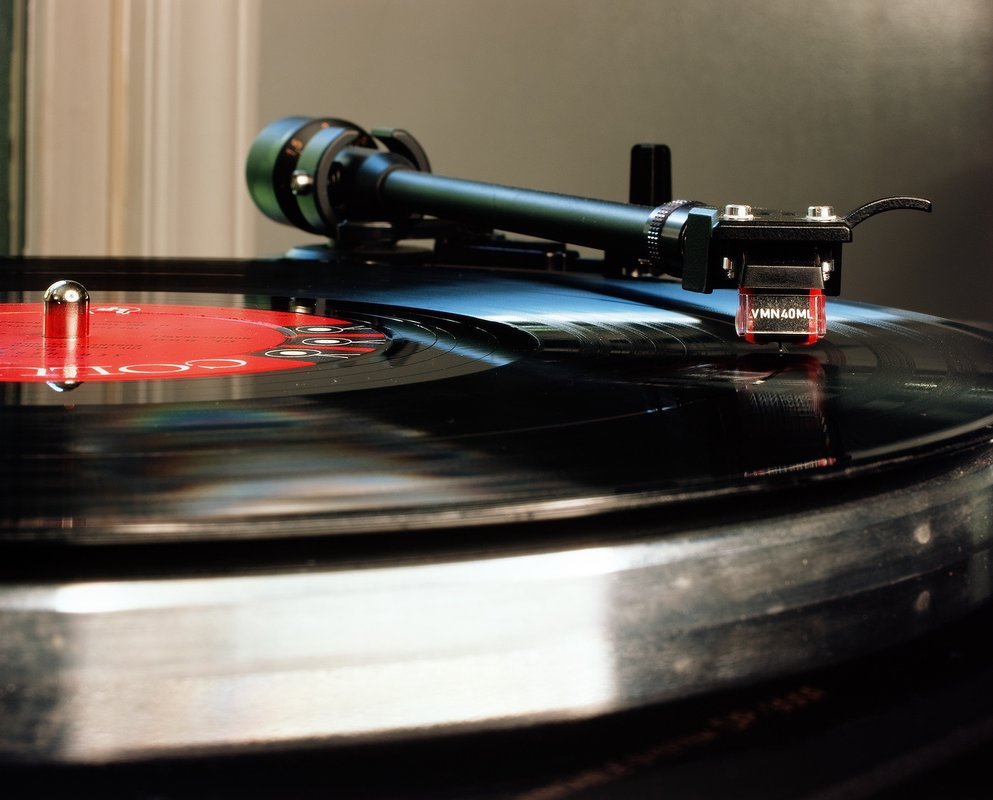
Someone on Reddit called this “the most analog thing they’d seen all day”. A late 1950’s pressing on vinyl, found by browsing in a thrift store. The audio chain from performance to medium to turntable to amplification to speaker drivers to my ear holes, spanning nearly 70 years from end to end, never once strays out of the analog domain. It sounds f##king awesome on a good sound system and I can easily feel the energy of the performance even though it happened almost a decade before my parents met.
The photograph of it is just as analog, captured on 4x5 color transparency film with a Sinar F camera. It arrived in the digital domain only because it’s hard to share a piece of film online otherwise, and was more or less a finished product before that point, needing only minor tonality and color balance tweaks to take it to this final image.
Later, P.